

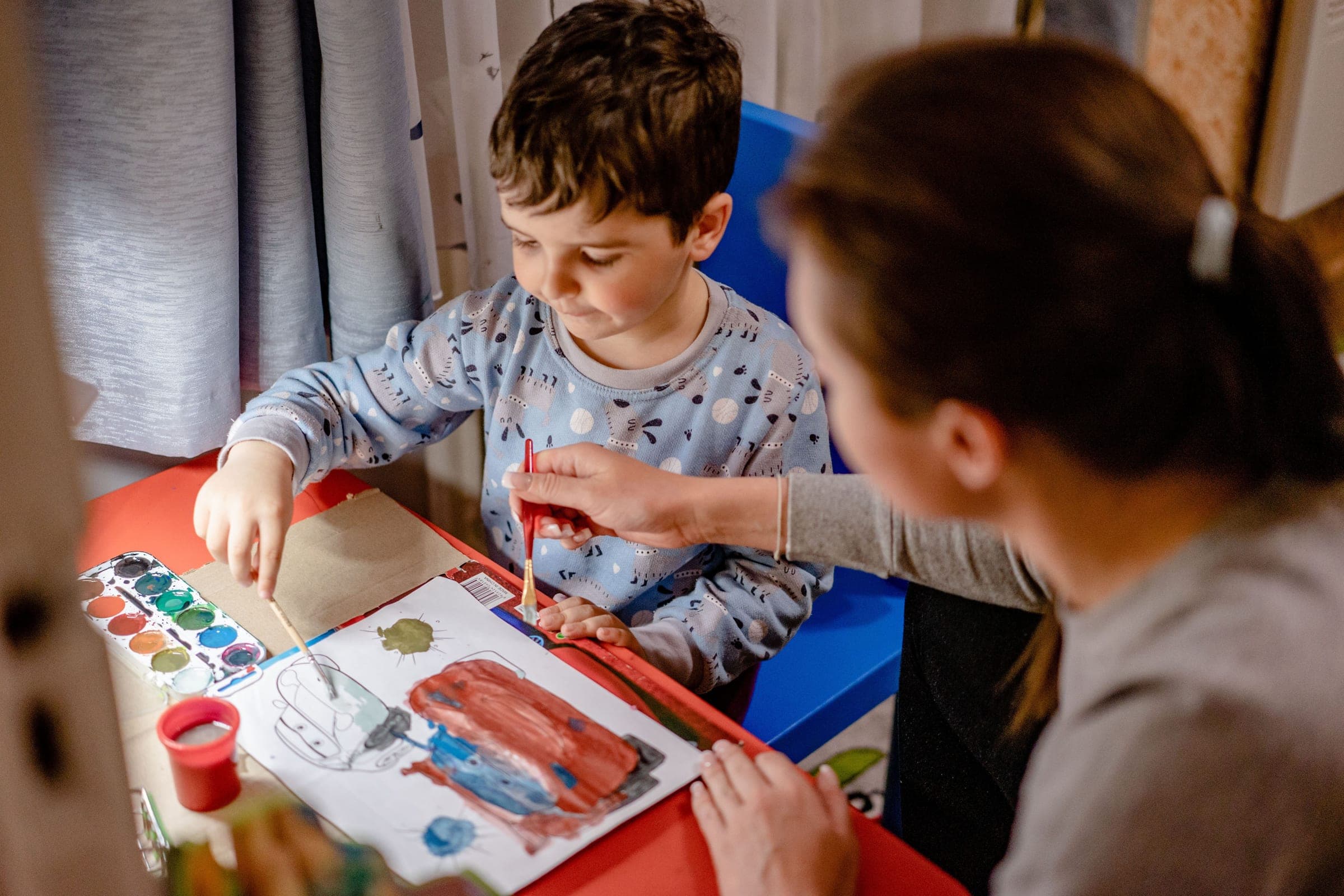
Creativity is not a talent of the chosen few and not "the art club". It is several processes every child has: seeing many options where an adult sees one; bearing uncertainty until a solution is found; and playing "as if". Research links preschoolers' pretend play with divergent thinking — the ability to generate many ideas; at the same time scientists honestly disagree on whether play makes a child creative or merely goes with it. What is known for certain: these processes can be trained, and rewards and grades get in their way. Below: what is known, what to play by age, what not to do, and how to tell that it is working.
What research says
Pretend play in childhood is linked with divergent thinking — and possibly with creativity in adulthood
Who and on whom. Sandra Russ, 2016, New Directions for Child and Adolescent Development. A review of the theory and the empirical work on pretend play as an antecedent of adult creativity.
What they found. The processes expressed in "as if" play — imagination, flexibility, work with feelings — are consistently associated with measures of creativity, especially divergent thinking; there is some longitudinal evidence that the association is stable over time. But there is no consensus that play itself makes a child more creative, and many other factors take part in adult creativity: opportunity, tolerance for failure, motivation, work habits.
What it does not prove. Association, not cause; small samples, varied methods. The review does not promise that play will raise an artist — it says that in play the very same processes are visible and are exercised.
"As if" play is a child's resource: it lowers anxiety and helps coping
Who and on whom. Melissa Moore and Sandra Russ, 2006, Journal of Developmental and Behavioral Pediatrics. A review of studies of play interventions in medical settings.
What they found. Pretend play relates to creativity, coping and emotion regulation; play interventions in hospitals reduced children's anxiety and distress and affected pain and behaviour. The effects were shown in the short term; long-term stability has not been demonstrated.
What it does not prove. The authors themselves acknowledge methodological limitations. For a parent the conclusion is more modest and more useful: free play is not "empty time" but the way a child processes experience.
A reward for an interesting activity lowers interest in it
Who and on whom. Edward Deci, Richard Koestner and Richard Ryan, 1999, Psychological Bulletin. A meta-analysis of 128 experiments.
What they found. Expected tangible rewards for an activity lowered intrinsic motivation and interest — in children more strongly than in students; verbal support, on the contrary, raised them.
What it does not prove. The study is not about creativity specifically but about motivation in general. But the main "don't" of this article follows from it: a prize for a drawing and a score for an idea turn play into paid work.
For a parent the three studies point the same way: creativity grows out of free play, tolerance for mistakes and intrinsic interest — and shrinks under prizes, grades and a timetable with no room left for play.
What to play — by age
Each game says which process it trains: options (divergent thinking), "as if" (imagination and roles), uncertainty (carrying on without a ready answer), transfer (an idea from one domain into another).
3–5 years
- "What could this be?" A box, a stick, a lid — ten uses in a row, laughing allowed. Trains: options.
- "Story in a circle". One sentence from each person; the one rule is not to cancel what someone else said but to continue it. Trains: "as if" and accepting another's idea.
- Props from around the house. A sheet, a saucepan, a torch — instead of "proper" toys with a single function. The less is built into an object, the more the child puts into it. Trains: "as if".
- "The blot". A splash of paint — and the question "what does it look like?", then draw it in. Trains: options and uncertainty.
6–9 years
- "Invention of the week". One household inconvenience — and a device from whatever is to hand that solves it, even if it is tape and cardboard. Works or not — we look at why. Trains: uncertainty and transfer.
- "A different ending". Rewrite the ending of a book or cartoon: what if the hero had acted differently. Trains: options and "as if".
- "Three-panel comic". A story with a beginning, a twist and an end on one sheet; stick figures are fine. Trains: carrying an idea through to a form.
- "Mistake-find". Not a competition in "who makes the most mistakes" but one find a week: what went wrong — and what interesting came of it. Trains: tolerance for mistakes — the very thing Russ's review names as a condition of adult creativity.
10–14 years
- "The constraint". A poem of ten words, a photo series on one theme in fifteen minutes, a story without the letter "e". The frame does not hinder ideas — it provokes them. Trains: options under conditions.
- "Something of my own, shown outside". A project with a result others will see: a play for the family, an exhibition on the fridge, a channel with five subscribers. We are not going to grade it — we are going to look. Trains: finishing, and carrying an idea into reality.
- "Swapping places". He teaches you what he does better — editing, a game, an app. You are a serious learner. Trains: the sense that "my ideas are valuable", without which creativity is hidden.
What not to do
- Reward and grade. A prize for the best drawing, points for ideas, top marks for a craft — by the meta-analysis this is exactly what lowers interest. Instead of a grade, a question: "tell me what's happening here?"
- Show the "right" way. "The sky is blue, not green", "you draw a house like this" — every such lesson takes away one option.
- Fix it for him. Gluing on, drawing over, rewriting "so it's nice" — the result becomes yours and the idea becomes unnecessary.
- Fill the whole day. Clubs, sports, tutors without a single empty hour: the free play that everything grows from needs free time and boredom.
- Read without permission. If a child has a notebook of ideas, it is his. Trust in personal space is the condition under which ideas get written down at all.
How to tell that it is working
The child offers options himself when something does not work — "how about this"; plays "as if" for longer and with more complex plots; carries ideas between domains — from a book into a drawing, from a cartoon into a game; and does not drop the work after the first failure. This takes months, and it shows not in the crafts but in how he thinks aloud.
Where culture comes in
In some countries a child's creativity is displayed and praised in public; in others it is treated as a private matter; in some places a "correct" drawing is valued above an original one. The games above do not argue with that: options, "as if" and tolerance for mistakes are trained in any culture, and how public to make the result is something you decide together with the child.
Sources
- Russ S. W. Pretend Play: Antecedent of Adult Creativity. New Directions for Child and Adolescent Development, 2016, 2016(151), 21–32. doi:10.1002/cad.20154
- Moore M., Russ S. W. Pretend play as a resource for children: Implications for pediatricians and health professionals. Journal of Developmental and Behavioral Pediatrics, 2006, 27(3), 237–248. doi:10.1097/00004703-200606000-00011
- Deci E. L., Koestner R., Ryan R. M. A meta-analytic review of experiments examining the effects of extrinsic rewards on intrinsic motivation. Psychological Bulletin, 1999, 125(6), 627–668. doi:10.1037/0033-2909.125.6.627
The games are examples, not a programme: fit them to your child. On how an interest in learning rests on the same three supports — in the piece on interest in learning.