

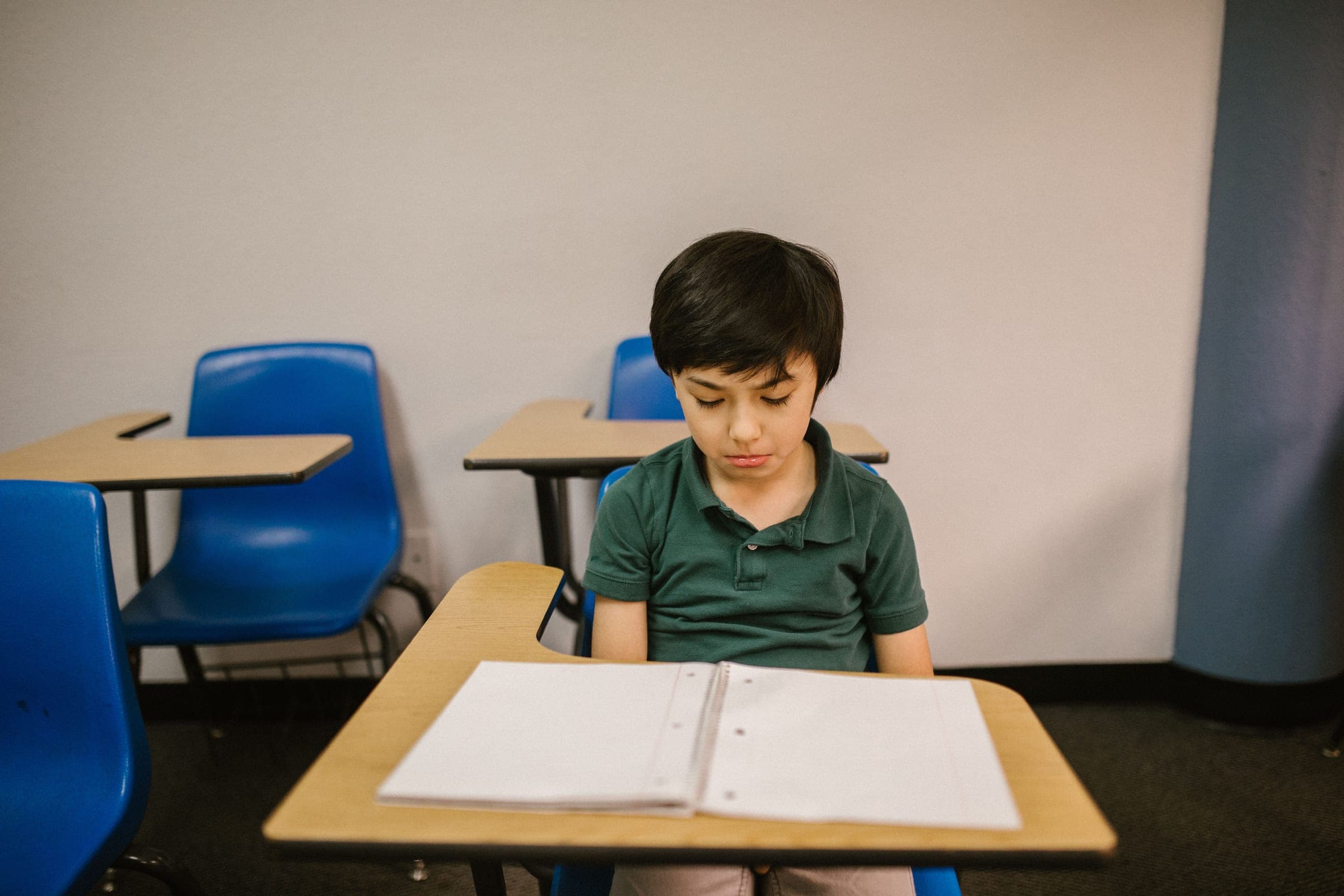
Bullying is not a quarrel, and it is not something "the kids will sort out themselves". It has two marks: it repeats, and the sides are not equal — one child against a group, or against someone stronger and older. Mockery, exclusion, damaged belongings, messages in class chats, shoves in the corridor: the form changes, the marks stay. Below is one scene taken apart. It is about a child who is the target, but bullying has other roles too, and each has its own fork.
The scene
For the third week a nine-year-old asks to stay home on Mondays and has "lost" his second hat in a month. In the parents' chat you happen to see a forwarded screenshot: the class is laughing at his photo. To the direct question "is anyone picking on you?" — "everything's fine".
What to do depends on the circumstances. The scene is an illustration, not a real family.
What to find out before acting
- Does it repeat — and are the sides unequal? A one-off quarrel between equals is a conflict, and children often handle those themselves. Repeated pressure by one child or a group on someone who cannot answer back is bullying, and it does not end on its own.
- Which role is your child in? The target; a bystander who laughs along or keeps quiet; the one who starts it. The roles differ — and so does what a parent does.
- Is there violence, are there threats, are there intimate photos? Shoves and blows, threats of harm, images being passed around — these change the pace: not "a word with the teacher this week" but the school's management at once, and where there are threats or violence, the police as well.
- What has the school already done — and does it have a procedure? Who is responsible for such cases, whom to write to, what measures exist.
- What is your child afraid of? Children keep quiet not out of stubbornness: they fear being judged and fear that things will get worse once adults step in. That fear is real and must shape how you intervene — not whether.
The forks: what you can do and what each one costs
If your child is the target
Action. A conversation without pressure and without the two lines that close it for good: "it's your own fault" and "hit back". Make it clear: you are not alone, we will deal with this together, none of this is your fault. Record the facts: dates, what happened, witnesses, screenshots. With the school — calmly and in writing: the class teacher, then the management and the school psychologist, asking for specific measures and dates. Do not confront the bullies or their parents directly. In parallel, support outside school: friends, an activity where he is in his element.
Cost. Time and persistence: the school may deny the problem, the child may beg you not to interfere. There will be no quick result.
What to watch. Whether it has stopped — by the signs below, not by "everything's fine". If the school does not respond, go higher, in writing, to the education authority. Where there is violence or threats — the police, without delay.
If he is a bystander — laughing along or keeping quiet
Action. Do not shame him. Explain how it works: bullying has roles, and laughter, a like under the photo, a forwarded screenshot are the fuel without which it dies out. Show what he can do at no risk to himself: not laugh, walk away, take the target with him, message him "this is not okay", tell an adult. That is not telling tales — it is protecting a person.
Cost. The fear of losing his place in the group is real, and heroism cannot be demanded of a child. It is enough to stop being fuel.
What to watch. Whether he starts telling you what is going on by himself. Whether "we" and "he" appear in his stories instead of "everyone".
If he is the one who starts it
Action. Do not excuse it ("that's how the world works", "they provoked him") and do not humiliate him in return. A consequence plus repairing the harm — an apology in deeds, not words under pressure. Find out what is behind it: status in the group, fear of becoming the target himself, copying what he sees at home or online. Work with the school, not against it.
Cost. Admitting it in front of other parents and the teacher. Denial is the one thing guaranteed to make it worse.
What to watch. Whether it repeats. Cruelty towards those who are weaker, or towards animals, that does not stop after you have stepped in is a reason to see a specialist.
There are no ready-made lines here on purpose: every family has its own words. All three forks mean the same thing — a child does not stop systematic bullying alone; adults and the group stop it.
What may be behind it
- Bullying is a group process. It rests not on one instigator but on those who assist, reinforce it with laughter and stay silent. That is why "dealing with the bully" rarely helps, while changing what the group does — does.
- Status. For the instigator and the reinforcers it is a way to take a place in the class hierarchy; for the bystanders, a way not to lose theirs.
- Children do not tell. They fear judgement, the label of "weakling", and things getting worse after adults intervene. The signs below matter more than direct questions.
- Online erases the line between school and home. Chats and photos make bullying round-the-clock and visible to everyone — which is why a child reacts so sharply to his phone.
What research says
Bullying has roles — and most children in it are neither "bully" nor "victim"
Who and on whom. Christina Salmivalli and colleagues, 1996, Aggressive Behavior. 573 Finnish sixth-graders aged 12–13.
What they found. Besides the victim and the bully, bullying has an assistant, a reinforcer (laughs, watches, cheers on), a defender and an outsider. The roles were related to a child's standing in the group; boys were more often bullies and reinforcers, girls more often defenders and outsiders.
What it does not prove. One country, one age group, self- and peer-ratings. The study explains how bullying is built, not how to stop it.
Peers are almost always present — and when they step in, it usually works
Who and on whom. Lynn Hawkins, Debra Pepler and Wendy Craig, 2001, Social Development. Naturalistic observations of bullying in school playgrounds; 58 children in grades 1–6 who intervened.
What they found. Peers were present in 88% of bullying episodes and intervened in 19%; the intervention stopped the bullying in 57% of cases. Interventions aimed at the bully tended to be aggressive; those aimed at the victim did not.
What it does not prove. Playground observations in one country; nothing about online bullying. But it is the main argument of the second fork: a bystander is not a spectator.
School anti-bullying programmes reduce bullying — moderately, but reliably
Who and on whom. Hannah Gaffney, Maria Ttofi and David Farrington, 2021, a Campbell systematic review. 100 evaluations of programmes, children and adolescents aged 4–18 in many countries.
What they found. Programmes reduce bullying perpetration by roughly 18–19% and victimisation by roughly 15–16%.
What it does not prove. The data rest mostly on children's self-reports: part of the effect may be a change in what is reported rather than in behaviour, and the spread between programmes is wide. For a parent the practical point stands: a school should have a procedure, and asking about it is normal.
By age
| Age | What changes |
|---|---|
| 5–7 | More often exclusion from play and name-calling than systematic bullying. Adults are nearby and can stop it at once; this is the age to teach that telling an adult is not telling tales. |
| 8–11 | The case above is about this age. Bullying becomes a group matter tied to status; children stop telling. Signs matter more than questions. |
| 12–14 | It moves into chats and photos and becomes round-the-clock; the risks are higher and the peers' role is decisive. Keeping the channel open matters more to a parent than "sorting it out" at once. |
Where culture comes in. "Hit back" and "don't tell tales" are the norm in some places and not in others; schools also differ in how they treat parents' complaints. The forks above do not argue with that: a child does not stop systematic bullying alone, wherever he goes to school.
Signs that something is wrong
- Behaviour. Withdrawn, irritable, often sad, has lost interest in school.
- Body. Headaches, stomach aches, sleeplessness with no visible cause; asking to stay home on particular days.
- Belongings. "Loses" school things and money, comes home with torn clothes or broken items.
- Company. Avoids talking about school and friends; is not invited to birthdays or into chats.
- Phone. Afraid to go online, or spends hours there looking crushed; deletes messages, gets nervous after reading something.
When to act immediately
Where there is physical violence, threats of harm or intimate images being passed around — the school's management and the police at once; keep the evidence. If a child says he does not want to live, or hurts himself, that is emergency help today, not a conversation with the school this week. How to talk with a child in an acute state — in the material on emotional intelligence; how to tell a quarrel from bullying between siblings — in the case on sibling jealousy.
Sources
- Salmivalli C., Lagerspetz K., Björkqvist K., Österman K., Kaukiainen A. Bullying as a group process: Participant roles and their relations to social status within the group. Aggressive Behavior, 1996, 22(1), 1–15. doi:10.1002/(SICI)1098-2337(1996)22:1<1::AID-AB1>3.0.CO;2-T
- Hawkins D. L., Pepler D. J., Craig W. M. Naturalistic Observations of Peer Interventions in Bullying. Social Development, 2001, 10(4), 512–527. doi:10.1111/1467-9507.00178
- Gaffney H., Ttofi M. M., Farrington D. P. Effectiveness of school-based programs to reduce bullying perpetration and victimization: An updated systematic review and meta-analysis. Campbell Systematic Reviews, 2021, 17(2), e1143. doi:10.1002/cl2.1143
The scene is an illustration, not a real family. This material does not replace an in-person consultation with a specialist and is not legal advice.