

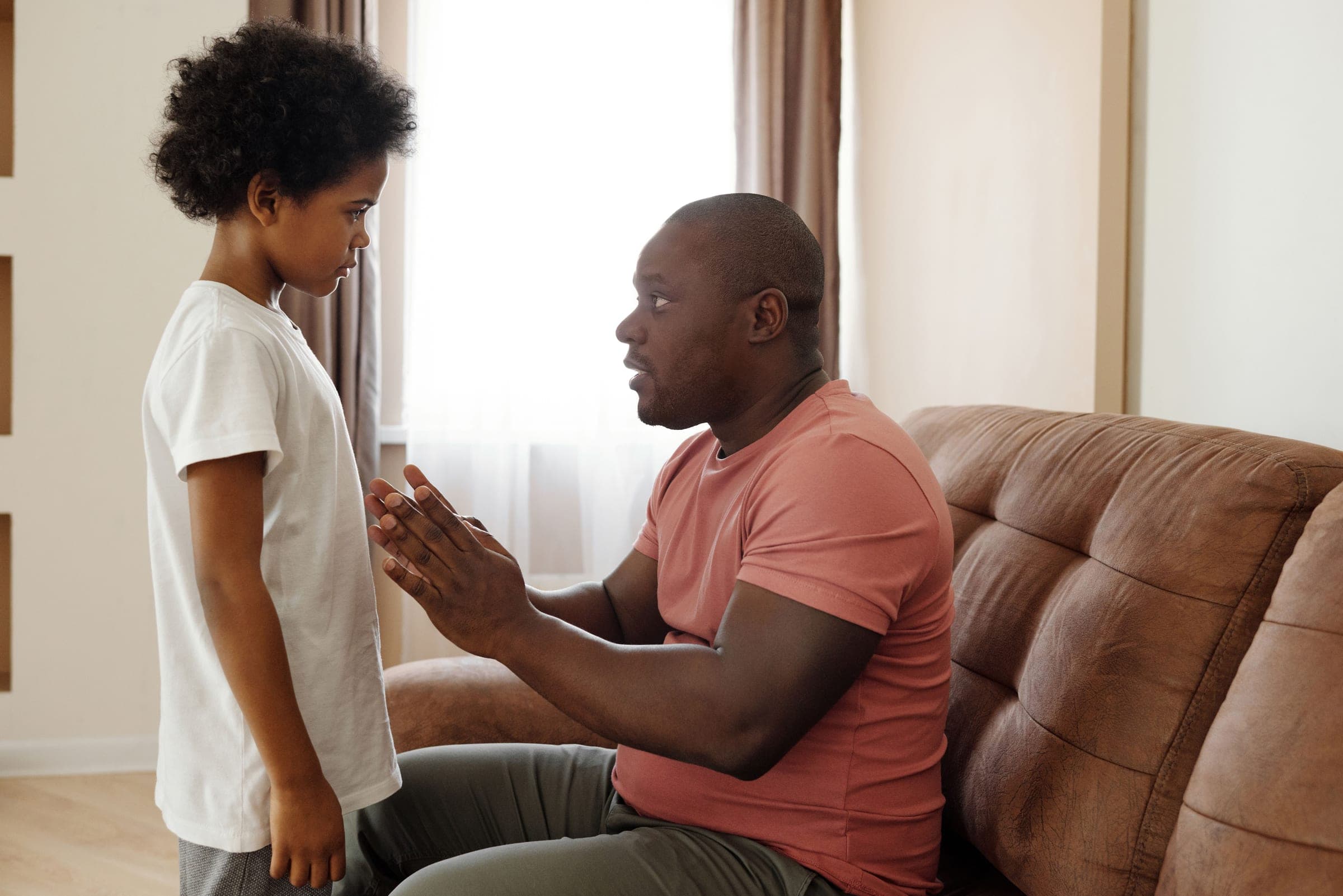
A child looks you in the eye and says, quite confidently, "It wasn't me." On the floor is a broken cup, and nobody else is around. The first lie a parent catches almost always comes as a shock and sets off an alarm: "Have I raised a liar?" Below is not a list of tips but one concrete scene taken apart: what to find out before acting, what to choose between, what each choice leads to, and what research knows about it.
The scene
A five-year-old. There was one sweet, and it was "after dinner". The sweet is gone; the wrapper is in his fist. Asked "did you take it?", he looks you in the eye and says "no". You press — tears, and "no" again.
One and the same scene is several different situations. They differ not in the deed but in the circumstances, and the circumstances decide what to do. The scene is an illustration, not a real family.
What to find out before acting
- Did he know the rule? Was "sweets after dinner" said out loud today — or does it live only in your head? At five, rules are remembered worse than adults think.
- First time, or a pattern? A single "no" and a steady chain of "took it → denies it" lead to different forks.
- What is he afraid of right now? Shouting, no cartoons, your disappointment? A child's "no" almost always answers the question "will something bad happen to me", not "did I take it".
- Can it be put right? If the harm is repairable — wait until dinner, give it back, apologise — the most useful fork is open: repair rather than punish.
The forks: what you can do and what each one costs
If it is the first time and the rule was vague
Action. Drop the question "did you or didn't you" — you know the answer. Name the fact calmly, without an interrogation, and agree the rule for next time.
Cost. The feeling that he "got away with it". The feeling is false: the goal here is the rule that did not exist, not a confession.
What to watch. Whether it repeats over the next weeks once the rule is clear. If it does, you are in the second fork.
If it repeats and he knows the rule
Action. Split it into two conversations: about the sweet — with a small consequence known in advance — and about the truth, separately and with no punishment for admitting it.
Cost. It takes restraint. Punishing the lie harder than the deed is the most reliable way to teach a child to lie better — see the research below.
What to watch. Whether he starts owning up by himself once owning up costs no more than the deed.
If he is in tears and the "no" keeps coming
Action. Stop the questioning. In this state a child is defending himself, not reasoning. Come back to it in an hour or two, in a calm moment.
Cost. The pause looks like a retreat. But a "yes" extracted through tears teaches one thing only: pressure works.
What to watch. Whether he brings it up himself later. He usually does.
There are no ready-made lines here on purpose: every family and every culture has its own words. All three forks mean the same thing — make the truth cheaper than the lie.
What may be behind it
Not one "true" explanation but several possible ones — each with its own signs.
- He has just learned that you don't know everything. Around four or five, children come to understand that another person has a different picture in their head. The first lie is often a by-product of that leap, not a flaw of character.
- "No" is about fear of the consequence, not about the fact. The scarier the expected reaction, the more stubborn the denial.
- Fantasy and play. For younger children the line between the imagined and the real is still blurred: "a dragon broke the cup" is imagination at work, not deceit.
- Wanting to please. Children quickly read which answer is expected and say what will make the adult happy.
- Testing a boundary. Sometimes it is literally an experiment: what happens if I say "no"? Whatever answer he gets becomes the lesson — in either direction.
- Imitation. If a child hears you ask someone to say "tell them I'm not home", he learns that lying when convenient is normal.
Understanding the cause does not mean approving of the lie. But the cause shows where to put the effort: removing fear and building trust, not "getting the truth out". On how a child learns to understand other people's feelings — the material on developing empathy.
What research says
Three studies that bear on the case. For each, what it showed — and what it does not prove.
In a punitive environment children lie more often — and hold the lie better
Who and on whom. Victoria Talwar and Kang Lee, 2011, Child Development. 84 three- and four-year-olds from two West African schools: one used corporal punishment, the other did not.
What they did. A child was left alone and asked not to peek at a toy; most peeked. Then the child was asked whether he had.
What they found. Children from the punitive school denied more often and kept the lie up better under follow-up questions. In their skill at lying, the three- and four-year-olds from that school matched six- and seven-year-olds from earlier studies.
What it does not prove. It is a natural experiment, not a random assignment: two schools in one region. It is about a school environment, not the family directly, and it does not say that gentleness by itself teaches honesty.
Lying appears together with understanding other minds and with self-control
Who and on whom. Talwar and Lee, 2008, Child Development. Children aged three to eight, the same toy task.
What they found. The first false "no" was related to understanding that another person may think differently, and to the ability to hold back an impulse. Keeping the lie going under further questions was related to a more complex grasp of other minds. Willingness to lie was also related to how the children themselves judged lying morally.
What it does not prove. That lying is "useful" or should be ignored. The study explains where lying comes from, not how to bring up a child.
Children begin to lie at two or three — and the older, the more often
Who and on whom. Angela Evans and Kang Lee, 2013, Developmental Psychology. 65 two- and three-year-olds.
What they found. 80% peeked. Most two-year-olds admitted it honestly; the older the child, the more often he denied it. With age accounted for, the tendency to lie was predicted by the development of executive function — the ability to manage one's own behaviour.
What it does not prove. Nothing about parenting: it is a study of development. A laboratory toy task is not a broken cup at home.
For a parent, all three point the same way: the first lie is a sign that a child's mind has grown, not that a liar has. How often and how skilfully he lies from here on depends on what the truth costs in his home.
By age
| Age | What changes |
|---|---|
| 2–4 | "No" is almost never a lie in our sense: the line between wished-for and real is still blurred. Nothing to investigate; a rule and a consequence — yes. |
| 5–7 | The case above is about this age. The truth has to be cheaper than the lie literally: the consequence for the deed smaller than the child expected. |
| 8–11 | Lying becomes strategic — for consequences, status, loyalty to friends. Separating "the deed" from "the truth" and predictable consequences work; pressure does not. |
| 12–14 | Silences and half-truths are more often about a right to privacy than about a sweet. Interrogation closes the channel; an agreement sometimes opens it. |
Where culture comes in. The norm of "own up at once" is not valued equally everywhere: in some places children are taught to smooth things over rather than speak plainly. The forks above do not argue with that. They are about the truth not costing more than the deed; how exactly it sounds in your family is up to you.
Honesty is not rudeness
What matters is not only the truth as fact but how it is said. Children easily confuse honesty with a licence to say anything: "Your present is awful — I'm just being honest." From early on it is worth showing the difference between three things: honesty (not distorting facts), rudeness (telling the truth so that it wounds) and tact (choosing words with respect for another person's feelings). The truth can be told kindly — and that skill is worth teaching alongside honesty itself. The foundation is the ability to read other people's emotions, that is, emotional intelligence.
Making the truth cheaper than the lie in advance
It is more reliable not to fight lies after the fact but to build a home where telling the truth is easy and safe. A few habits that work every day:
- Set the example. Children read deeds, not words. When adults keep promises and admit their mistakes aloud, a child takes honesty as the norm.
- Make the truth pay. Let owning up soften consequences rather than sharpen them. "Thank you for telling me the truth" builds honesty faster than any lecture.
- Call honesty a value. Notice the moments when the child was honest, even in small things: that is how he sees the quality is noticed.
- Don't ask leading questions. "You didn't break the vase, did you?" pushes a child to defend himself with a lie. Calmer: "The vase is broken. Let's work out together what happened."
All of this rests on the same foundation as boundaries and rules without shouting — predictability and warmth. And if you feel yourself boiling over at the moment of discovery, parental anger has a material of its own.
Parents' frequent questions
Should a child be punished for lying?
Harsh or emotional punishment for lying more often teaches cunning than honesty: the child begins to lie more skilfully so as not to get caught — exactly what Talwar and Lee found in 2011. It is wiser to separate two things: discuss the consequences of the deed, and separately support the very fact of owning up.
How should I react to a child's fantasies?
A preschooler's fantasies should not be called lies. You can play along and then gently mark the line: "Great story! Now tell me how it really happened." That way the child learns to tell invention from truth without fearing punishment.
What if a child lies all the time?
Systematic lying is almost always a signal, not a cause. Look closer: are the rules and punishments too strict, does the child get enough attention, is he copying something around him. If the worry persists, it makes sense to see a child psychologist in person.
How do I teach a child to tell the truth without hurting others?
Separate honesty and tact with examples: "You can say you don't like the present, but first thank them for thinking of you." Truth and respect for another's feelings do not contradict each other — that is what we teach.
Sources
- Talwar V., Lee K. A Punitive Environment Fosters Children's Dishonesty: A Natural Experiment. Child Development, 2011, 82(6), 1751–1758. doi:10.1111/j.1467-8624.2011.01663.x
- Talwar V., Lee K. Social and Cognitive Correlates of Children's Lying Behavior. Child Development, 2008, 79(4), 866–881. doi:10.1111/j.1467-8624.2008.01164.x
- Evans A. D., Lee K. Emergence of Lying in Very Young Children. Developmental Psychology, 2013. PubMed 23294150
The scene is an illustration, not a real family. This material does not replace an in-person consultation with a specialist.