

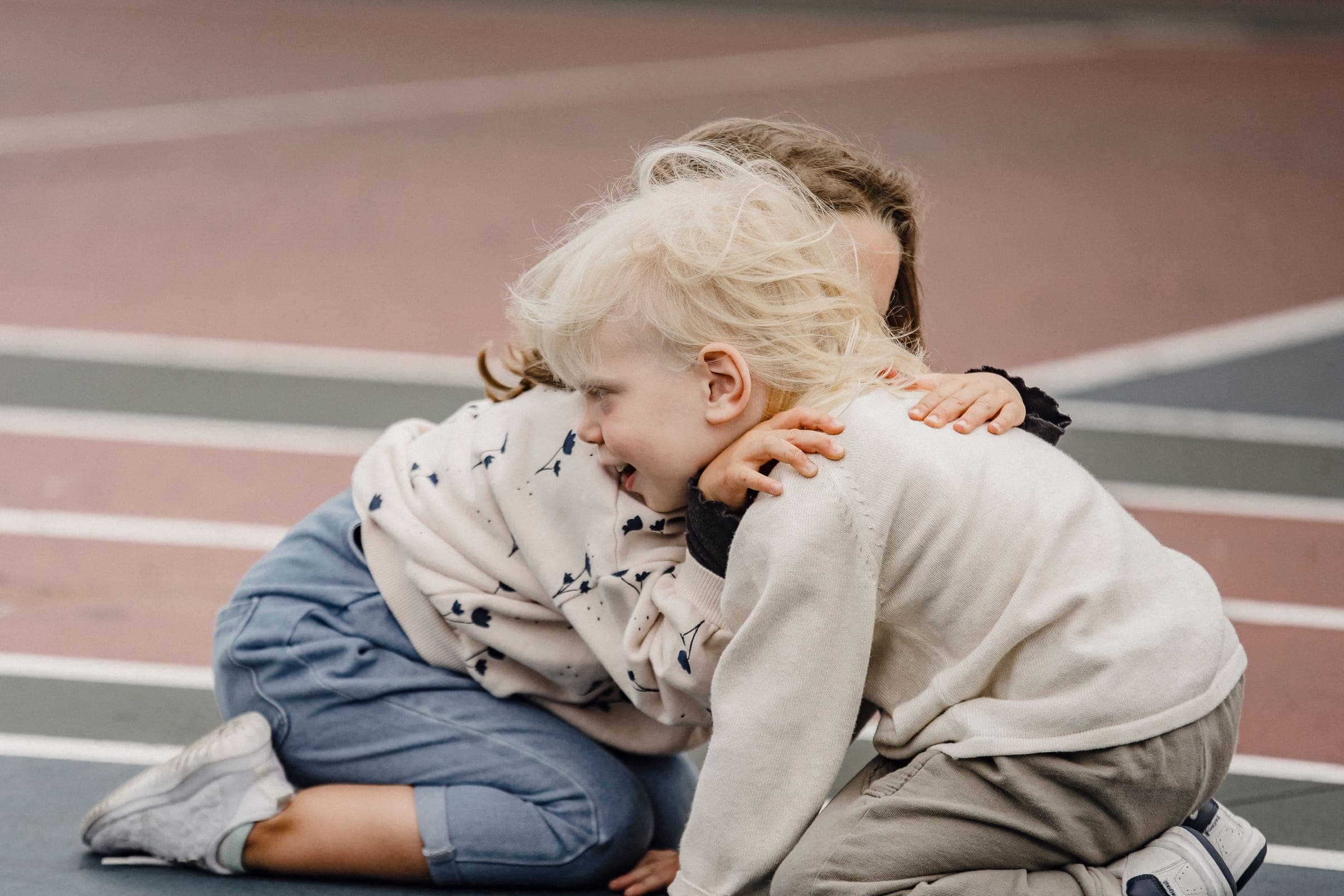
Parents usually want a finished result from empathy: that the child shares toys, feels for a younger sibling, does not tease classmates. But empathy is not a set of good deeds; it is a skill assembled from three parts: noticing another person's feeling, understanding its cause, and taking it into account in one's own action. Each part can be trained — and best of all not by talks about kindness but by play and a living example. Below is how this skill grows by age and what to play at each stage.
What empathy is — and what it is not
Empathy is the ability to understand another person's feelings and respond to them. It is important to separate it from what it gets confused with. Empathy is not pity: the one who pities looks down from above, the one who empathises stands alongside. It is not politeness: you can say "please" and not notice that someone is unwell. And it is not a duty to rescue everyone and give way to everyone: understanding another's feeling does not mean agreeing with another's demand.
For us at the club this distinction is fundamental: empathy is the basis of moral choice, not a way of being convenient. A child with developed empathy does not "always give way" — he sees what is happening with the other person and chooses an action with that in mind. Sometimes that action is to help, sometimes to say "no", sometimes to call an adult.
When does empathy appear in children?
Earlier than is commonly thought — and later than parents would like. Even infants catch other people's emotions: one starts crying and the whole ward cries. A two- or three-year-old notices that mum is sad and brings her his teddy bear: sympathy is already there, but he helps with what would have comforted himself. Between three and five a key shift takes place — the child begins to understand that another person feels and thinks differently from him (see the research below). From that moment you can seriously discuss with him "what is it like for her?". By six or seven an understanding of mixed feelings is added ("glad about the present and hurt that it is the wrong one"), and for nine- to twelve-year-olds the main test is to keep their sympathy under group pressure, when "everyone is laughing" at one person.
Hence the rule: games and conversations must fit the age. Demanding that a three-year-old understand his sister's hurt "from the inside" is too early; limiting a ten-year-old to emotion cards is too late.
What research says
Three studies that bear on the matter. For each, what it showed — and what it does not prove.
Sympathy is visible at just over a year — and grows towards age three
Who and on whom. Ariel Knafo, Carolyn Zahn-Waxler and colleagues, 2008, Emotion. 409 pairs of twins; several times between 14 and 36 months the researchers observed how the children reacted to simulated pain shown by their mother and by an examiner.
What they found. Empathic concern, attempts to work out what had happened, and helping all increased from 14 to 36 months. Empathy proved to be a relatively stable disposition — consistent across ages, between its feeling and understanding sides, and between the reaction to the mother and to an unfamiliar adult. With age the contribution of heredity grew and the contribution of the shared family environment shrank; but the link between empathy and actual helping was explained mainly by environment.
What it does not prove. Twins, a laboratory, one country; simulated pain is not real trouble. And it is not an argument that "empathy is innate, nothing to raise": on these data it is precisely the step from feeling to action that depends on what adults do.
Understanding that another person thinks differently forms in the preschool years — in every country
Who and on whom. Henry Wellman, David Cross and Julanne Watson, 2001, Child Development. A meta-analysis of 178 studies of "false belief" tasks — the test of whether a child understands that another person can hold as true something that is not.
What they found. Preschoolers moved from below-chance to above-chance performance, and this pattern repeated across countries and across variants of the task. The authors conclude that this is a genuine shift in understanding other minds during the preschool years, not an artefact of the tasks.
What it does not prove. The false-belief test is not a test of empathy: it concerns understanding other people's thoughts, one of the three supports of the skill, not sympathy. But for a parent the conclusion is practical: the question "what is it like for her?" begins to work in earnest in the preschool years, and this is development that cannot be hurried by demanding it.
Empathy can be trained — and it is better to start early and work on several of its parts
Who and on whom. Tina Malti and colleagues, 2016, Journal of Clinical Child and Adolescent Psychology. An analysis of 19 school-based programmes with strong empirical support that target empathy in children and adolescents.
What they found. Most programmes allowed for differences between grades; none allowed for differences within a grade. Starting earlier and targeting a larger number of components of empathy were, in part, associated with larger effects.
What it does not prove. School programmes, not games at home; the effects vary and are not always lasting. But the direction matches how the games below are built: start young and train all three parts — noticing, understanding, acting.
For a parent the three studies point the same way: a child has sympathy long before words, understanding of other minds arrives in the preschool years by itself, and the turning of feeling into action is the part that adults grow — by play, by example, and by a question instead of a command.
Games for developing empathy: ages 3–5
- "Mirror". You show a feeling with your face — the child guesses and repeats it; then you swap. This trains the very first layer of empathy: reading an emotion from a face.
- "What is the character feeling?" At every vivid picture in a book, a short stop: "Look at the hare. What is he like — cheerful, frightened? And why?" One book, ten little training sessions.
- A real care of his own. Water the plant, pour the cat's food, take grandma her tea — not "helping around the house" but a personal area of responsibility for something alive. The habit of sympathy grows out of deeds, not out of talks about kindness.
- Voice other people's feelings at the playground. "The boy is crying — his car broke. Remember how upset you were when your balloon burst?" The bridge from another's feeling to his own experience is the main mechanism at this age.
Games for developing empathy: ages 6–8
- "Swap roles". Act out yesterday's quarrel, but the child plays you and you play him. Laughter is guaranteed, and at the same time the child hears himself from the outside for the first time — an exercise in changing perspective, the core of empathy.
- "Guess the feeling". Charades where the words to guess are not animals but emotions: show "hurt", "pride", "embarrassment" without words. It widens the vocabulary of feelings — and whoever can name can also notice.
- Freeze-frame in a cartoon. At a conflict scene, pause and ask two questions: "What is this one feeling? And that one?" The secret is to ask about both — including the "bad" one. Understanding the offender's feelings does not mean approving of his deed, and this distinction is worth saying out loud.
- Losing at a board game. Do not always let him win: a lived-through loss is a sympathy trainer. The loser gets to know this feeling from the inside; the winner learns to be glad without trampling the opponent.
- A card for someone who is unwell. A classmate is ill, grandma is sad — suggest drawing or writing something for them. The child makes the effort to imagine: what would cheer this person up? That is already empathy in action.
Games and practices: ages 9–12
- "Two truths". Take one conflict — from life, a book or the news — and tell it twice: from the point of view of each participant, seriously, without caricature. The child's task is to find how each is right in their own way. This exercise prepares for the hardest thing: sympathising with people you disagree with.
- An interview with the elders. Let the child question grandma or grandpa: what were you afraid of at my age? What did you dream of? The discovery that adults have an inner life of their own is the strongest push to empathy at this age.
- Real help, not playing at it. An animal shelter, collecting clothes, helping a neighbour — on one condition: the child takes part in choosing whom and how to help. "Goodness under the stick" assigned from above develops not empathy but an aversion to it.
- Conversations about "everyone laughed". School stories about the class teasing someone are not an occasion for a lecture but material: "What do you think he felt? And the ones who laughed along — how was it for them?" This is exactly where empathy meets the subject of bullying — more on it in the article on school bullying.
Which adult mistakes kill empathy?
- A forced "feel sorry" and "say sorry". Sympathy squeezed out of a child teaches him to portray a feeling, not to feel it. A question works instead of a command: "How can you help him?" What repair looks like without a squeezed-out "sorry" — in the case on a child who took something that isn't his.
- Shaming for "callousness". "Aren't you ashamed, he's crying!" — the child hears not about the other person's feelings but about being bad himself. Shame closes empathy rather than opening it.
- Dismissing his own feelings. A child who is told "stop bawling, it's nothing" learns the main thing: feelings are nothing. Other people's too. Empathy for others begins with being taken seriously yourself — this is the foundation of all emotional intelligence.
- Comparing with "kind" children. "Look, Masha always shares" grows not kindness but resentment of Masha — and of you along with her.
- Demanding sympathy for the one who hurts him. "Understand your brother, he's little" after every snatched toy teaches him to tolerate injustice, not to empathise. First protection and acknowledgement of his hurt, then a conversation about the other's feelings. How to sort this out between children — in the article on sibling rivalry.
Empathy and boundaries: why sensitivity is not softness
The last and perhaps most important point. Parents sometimes worry: raise one who is too kind and people will take advantage. The worry is understandable, but it is about something else. The ones taken advantage of are precisely those who do not distinguish "understand" from "give way" — and that is a shortage of boundaries, not an excess of empathy.
So teach both skills as a pair. "I can see you're upset — and it's still my car, I'll give it to you when I've finished" is the sentence of a seven-year-old whose empathy and boundaries are both in order. Such a child can notice another's pain, help by his own choice, and say "no" without guilt. That, in fact, is the aim: not convenient kindness for show, but an inner ability to take others into account — while remaining himself.
Sources
- Knafo A., Zahn-Waxler C., Van Hulle C., Robinson J. L., Rhee S. H. The developmental origins of a disposition toward empathy: Genetic and environmental contributions. Emotion, 2008, 8(6), 737–752. doi:10.1037/a0014179
- Wellman H. M., Cross D., Watson J. Meta-analysis of theory-of-mind development: The truth about false belief. Child Development, 2001, 72(3), 655–684. doi:10.1111/1467-8624.00304
- Malti T., Chaparro M. P., Zuffianò A., Colasante T. School-based interventions to promote empathy-related responding in children and adolescents: A developmental analysis. Journal of Clinical Child and Adolescent Psychology, 2016, 45(6), 718–731. doi:10.1080/15374416.2015.1121822
The games are examples, not a programme: adapt them to your child. This material does not replace an in-person consultation with a specialist.