

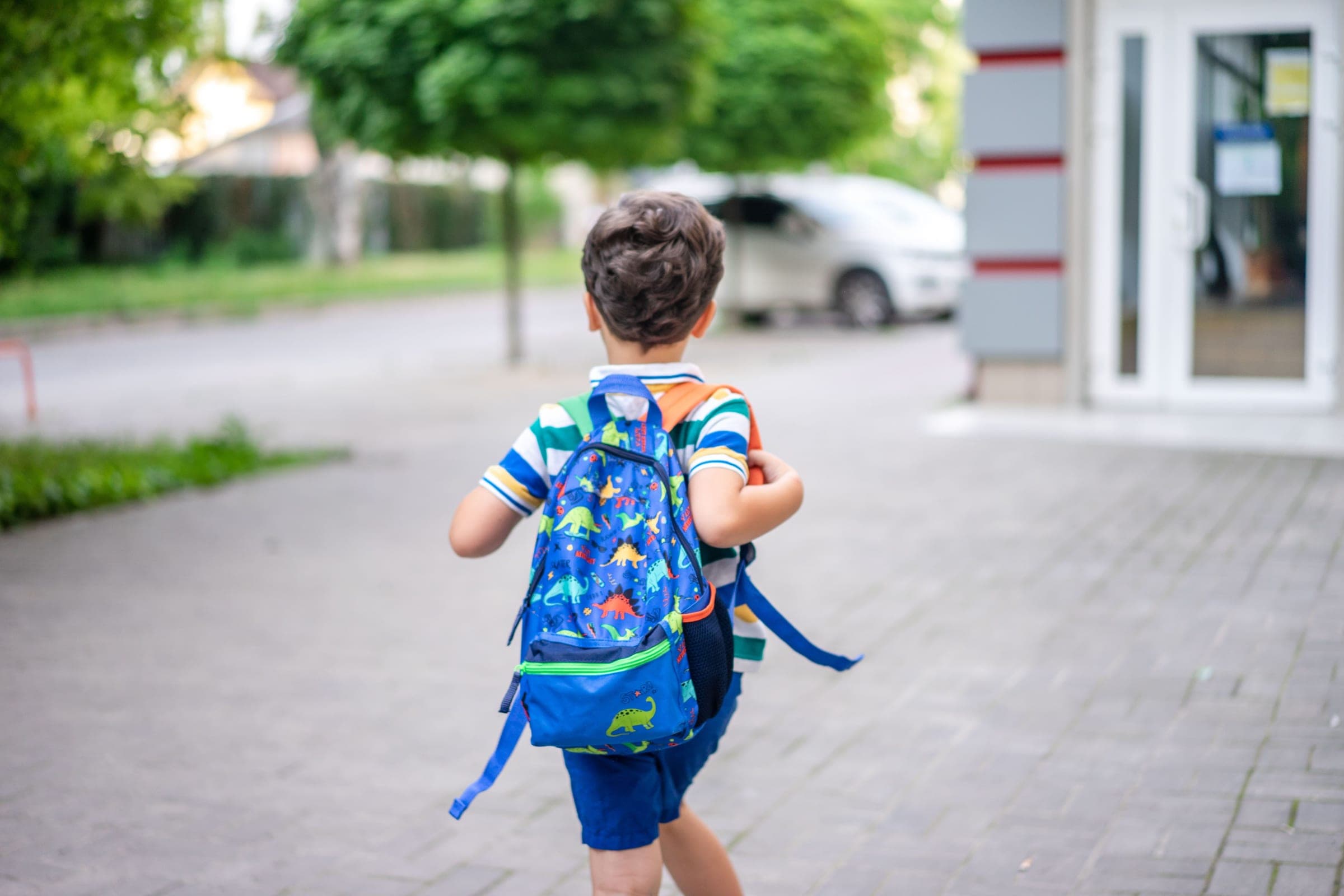
"I'm not going to school." In August it is said calmly, over dinner; in September it comes with tears and "my tummy hurts". A first-grader is not being difficult and is not lazy: he has landed in a world where he is the smallest again and does not know the rules. Below is not a list of tips but one scene taken apart: what to find out before acting, what to choose between, what each choice leads to, and what research knows about it.
The scene
Second week of September. A first-grader in the morning: "My tummy hurts. I'm not going." Yesterday he came home from school drained and snapped at everyone, and the teacher said: "he behaves beautifully in class." You are late for work.
One and the same scene is several different situations. They differ not in the force of the protest but in what stands behind it and how it changes week by week. The scene is an illustration, not a real family.
What to find out before acting
- Does his tummy really hurt — and what did the paediatrician say? Anxiety in children often speaks the language of the body: stomach ache, nausea, "my legs won't go". It is not pretending, and scolding him for it is pointless. First rule out a medical cause, then look at the pattern. The American Academy of Pediatrics describes it like this: headaches, stomach aches, nausea or dizziness happen mostly on school days and are usually absent at weekends, and the doctor finds no illness on examination. That pattern is more likely about school than about the stomach.
- Is the refusal general, or about something specific? "I don't want to go to school" is too big an answer for a seven-year-old. The teacher, one particular child, the toilet, the canteen, fear of being late or of getting it wrong at the board — a specific fear is solved specifically; the general anxiety of the first weeks is solved by predictability.
- How long has it lasted, and is there a trend? The first two to four weeks are adaptation, and one hard morning is too early to judge by. No trend by the end of the first month is a signal.
- Does he have at least one friend of his own in the class? Friends in the classroom predict how a child feels about school more strongly than adults think (see the research below). Many first-graders worry about friendship no less than about lessons — and talk about it less.
- What came before school, and what else changed? A move, a new baby, a divorce, your return to work — several changes at once, and school gets blamed for all of them.
The forks: what you can do and what each one costs
If it is the anxiety of the first weeks with no specific cause
Action. Acknowledge the pain but keep the order of life: "I believe it hurts; when you're worried your tummy tightens, that happens; we'll walk to school and I'll be reachable — if it gets worse, tell the teacher." Reduce the unknown rather than painting delights: the plan of the day, the route, the teacher's name, the exact pick-up time. A morning without a battle — school bag and clothes ready the night before, waking up with time to spare. The goodbye at the school gate short and confident: a hug, the time named, handed over to the teacher, gone. In the evening — specific questions instead of "how was it": "who did you sit with? what was the most boring part?" And the right to find it hard: "the first weeks are tough for lots of children; whatever happens, you'll tell me in the evening."
Cost. Morning tears in front of you and giving up "all right, stay home today": one day off for the sake of a quiet morning makes the next morning harder, not easier.
What to watch. Whether he settles during the day — ask the teacher not "did he cry" but "how many minutes until he got down to work". Weekends without complaints. Whether mornings are easier by the end of the first month.
If the cause is specific — a teacher, a child, embarrassment
Action. Find it not by interrogation but through play and drawing: "draw your class", "at the dolls' school today…". Then solve the cause, not the refusal: about the toilet and the canteen — a word with the teacher; about fear of the teacher — a meeting of the three of you; about a classmate who is hurting him — the case on bullying, not "he'll sort it out himself". If the problem is having nobody to be friends with, rehearse opening lines at home ("what are you playing? can I join?") and create occasions: walk home with a classmate, invite someone to the playground.
Cost. Time and, possibly, an unpleasant conversation with the school. The temptation "not to spoil relations with the teacher" costs more here.
What to watch. Whether the refusal goes once the cause is solved. If it does, the cause was the issue, not his "character".
If the refusal lasts more than a month, complaints grow and absences pile up
Action. The paediatrician, if you have not been yet; a child psychologist — anxious school refusal is linked with anxiety and depressive states (see the research below), and that is treated, not "outgrown". Agree with the school on a partial return — half days, some lessons — instead of a full absence: the longer a child stays home, the further away school gets, and absences become a risk factor in their own right. At home, do not punish the refusal and do not turn a missed day into a holiday with cartoons.
Cost. Admitting that "it'll pass by itself" did not work, and spending working hours on it.
What to watch. Sleep, food, mood, what he says about himself ("I'm stupid", "nobody likes me"). If these appear — the section "when to see a specialist", without delay.
There are no ready-made lines here on purpose: every family has its own words. All three forks mean the same thing: the anxiety of the first weeks is treated with predictability and presence, a specific cause with its solution, and a refusal that drags on with a specialist, not with patience.
What may be behind it
- The unknown and lost status. At nursery he was the oldest and knew everything; at school he is the smallest again and does not know where the toilet is or whether he may leave the room.
- Two feelings at once. Wanting to be a schoolchild — and being scared to go. In the morning he proudly tries on the school bag, in the evening he cries that he won't go; that is not manipulation but two real feelings crowded together. Psychologists link it to the crisis of six to seven and to what Lidia Bozhovich called the inner position of a schoolchild — the need to take a new, serious place in life.
- The load on attention. Sitting, listening, not jumping up, waiting for his turn — voluntary attention is only forming at this age. He comes home drained and lets it out where it is safe.
- Separation. For some children it is not about school but about mum leaving — the same mechanism as in the nursery cloakroom: the case on tears at drop-off.
- A specific cause. A teacher, a child, embarrassment in front of the class. Then this is not adaptation.
- An anxious state. If the refusal holds and sleep, food and mood have joined it, this is no longer about first grade.
What research says
Anxious school refusal and truancy are different things — and anxiety and depression often stand behind the first
Who and on whom. Helen Egger, Jane Costello and Adrian Angold, 2003, Journal of the American Academy of Child and Adolescent Psychiatry. Eight annual waves of structured interviews with 9- to 16-year-olds and their parents in the Great Smoky Mountains Study.
What they found. Pure anxious school refusal was associated with depression (odds 13 times higher) and separation anxiety (8.7 times); pure truancy with oppositional and conduct problems. Among children who showed both, a psychiatric disorder was found in 88% of cases. Fears, sleep difficulties, physical complaints and peer difficulties combined differently with the different types of refusal.
What it does not prove. Children older than first-graders, one country, associations rather than causes. But the conclusion carries over: refusal with tears and a stomach ache and refusal as "just didn't go" are different states, and they cannot be treated the same way.
Friends in the classroom from the first weeks predict whether a child will come to like school
Who and on whom. Gary Ladd, 1990, Child Development. 125 children in their first school year: peer relationships measured at entry, after two months and at the end of the year.
What they found. Children with more classroom friends at entry had more favourable views of school by the second month; those who kept these friendships liked school more as the year went on. Making new friends went together with gains in performance; early rejection by peers predicted less favourable views of school, more avoidance of it and lower performance over the year.
What it does not prove. One country, observation rather than experiment: perhaps children who find school easier also make friends more easily. But for a parent the conclusion is practical: asking "who did you sit with?" matters more than "what mark did you get?".
Missing school is a risk factor in itself, not only a sign of one
Who and on whom. Christopher Kearney, 2008, Clinical Psychology Review. A review of research on school absenteeism and school refusal: prevalence, comorbid conditions, risk factors, help.
What they found. Unexcused absences are more common than the major childhood behaviour disorders and are linked with the risk of injury, substance use, psychiatric disorders and poverty in adulthood. Risk factors include school climate and connectedness, victimisation, parental involvement and family circumstances.
What it does not prove. A review, not a single study; it covers the whole school age and mostly the United States. But it explains why "let him stay home until he calms down" is a dangerous strategy: every missed day pushes school further away.
For a parent the three studies point the same way: anxious refusal is a state, not a character; friends in the classroom matter more than marks; and home instead of school "until it passes" makes things worse — the child needs to go back, at least in part, and with help if it does not happen by itself.
By age
| Age | What changes |
|---|---|
| 5–6 | Before school: fear of the unknown, not of school. The route on a day off, the yard and the entrance, the plan of the day, a routine shifted in advance by a quarter of an hour every two or three days. "Silly" questions about the toilet are a map of his fears — answer them seriously. |
| 7–8 | The case above is about this age. The tummy really hurts; the order of life holds; letting off steam at home in the evening is normal in the first weeks; friends matter more than marks. Ask specific questions, not "how was it". |
| 9–11 | Refusal is almost always about something specific: a teacher, marks, the class, bullying. The child can already explain, if not asked head-on. "I'm stupid" after school — the case on self-esteem. |
| 12–14 | Anxious refusal and truancy part ways for good: the first comes with tears and physical complaints, the second with secrecy and a crowd. Behind the first at this age there is often depression — a specialist, not lectures. |
Where culture comes in. Schools differ: in some places the first day is a ceremony, in others an ordinary day; in some the teacher is an authority not to be questioned, in others a partner of the parents. The forks above do not argue with that: predictability, a kept routine and a found cause work in any school — how you talk to the teacher is up to you.
When to see a specialist
Morning tears in the first weeks are part of adaptation. Take notice if the refusal lasts more than a month with no trend; if physical complaints grow and the doctor finds no cause; if the child has been out of school for more than a week without illness — the American Academy of Pediatrics names exactly this point as the one after which the family needs a specialist's help; if the child has stopped eating, sleeps badly, has withdrawn, speaks badly of himself or says it would be better if he did not exist; if he is terrified of a particular person at school or says he is being hurt. The last is dealt with through the school; the rest — a child psychologist, and not "after the holidays". If it is you who loses your temper over the morning rush — the case on parental anger.
What a child learns when he is not kept at home
That a fear can be named, taken along and walked through all the same — and that in the evening he will be listened to rather than asked about marks. It is his first experience that hard things can be got through, and it will stay with him longer than first grade. How to teach a child to name feelings before they turn into a stomach ache — in the article on emotional intelligence.
Sources
- Egger H. L., Costello E. J., Angold A. School refusal and psychiatric disorders: A community study. Journal of the American Academy of Child and Adolescent Psychiatry, 2003, 42(7), 797–807. doi:10.1097/01.CHI.0000046865.56865.79
- Ladd G. W. Having friends, keeping friends, making friends, and being liked by peers in the classroom: Predictors of children's early school adjustment? Child Development, 1990, 61(4), 1081–1100. PubMed 2209179
- Kearney C. A. School absenteeism and school refusal behavior in youth: A contemporary review. Clinical Psychology Review, 2008, 28(3), 451–471. doi:10.1016/j.cpr.2007.07.012
- American Academy of Pediatrics. School Avoidance: Tips for Concerned Parents. HealthyChildren.org. healthychildren.org
The scene is an illustration, not a real family. This material does not replace an in-person consultation with a paediatrician and a psychologist.