

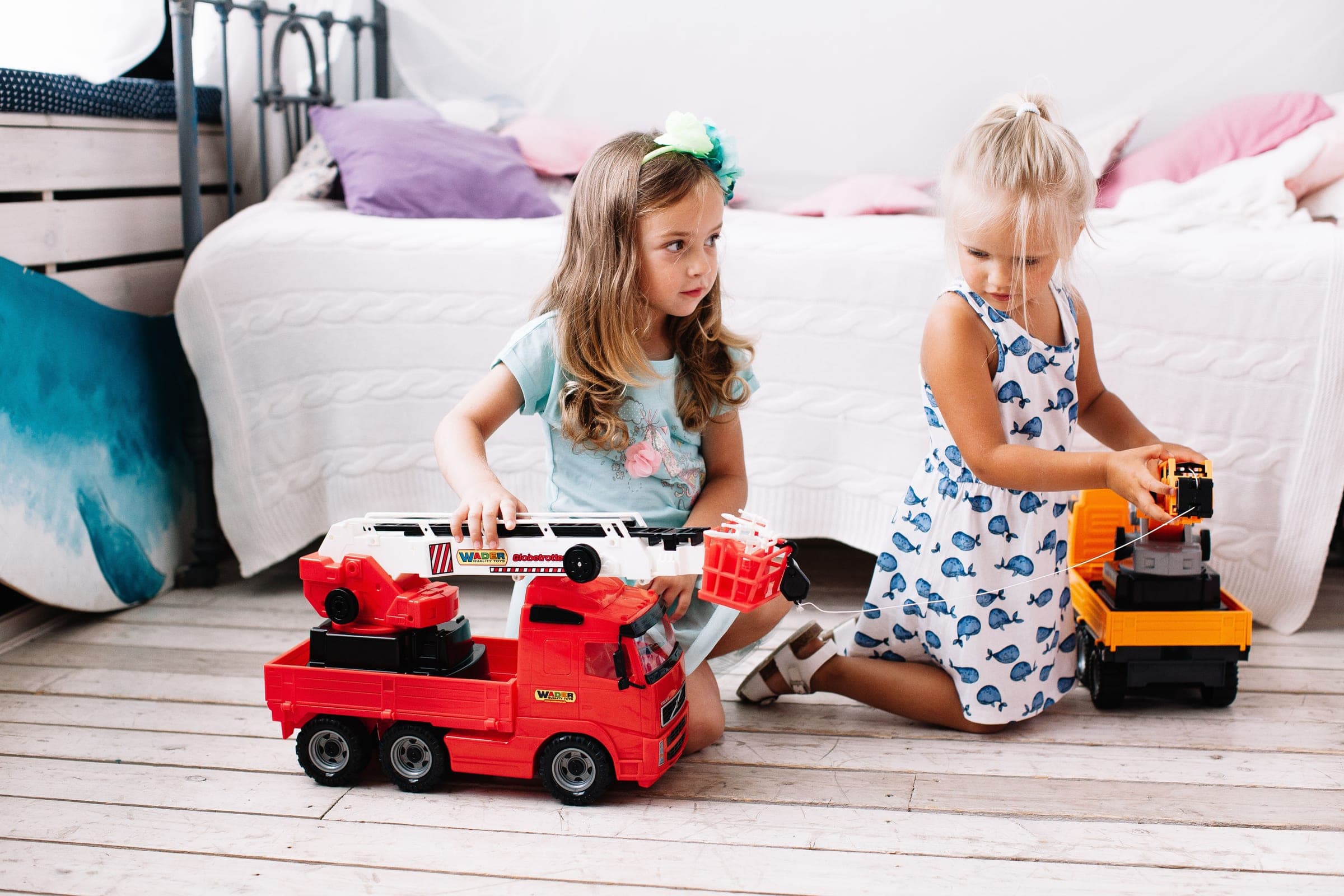
"He doesn't love me", "you're always on his side", "why did you even have him" — lines almost every family with two or more children hears sooner or later. Rivalry between brothers and sisters (psychologists call it sibling competition) is not a sign of bad parenting and not a breakdown in the relationship. It is a child's normal reaction to the fact that a parent's attention is a resource, and it now has to be shared. Below is not a list of tips but one scene taken apart: what to find out before acting, what to choose between, what each choice leads to, and what research knows about it.
The scene
The younger one is eight months old and you are feeding him. The five-year-old walks up and shoves the walker — not hard, but on purpose. To your "stop" he answers: "You love him more. Why did you even have him?" — and bursts into tears.
One and the same scene is several different situations. They differ not in the deed but in the circumstances, and the circumstances decide what to do. The scene is an illustration, not a real family.
What to find out before acting
- How long since the younger one was born — and what else changed at the same time? The first months are the sharpest period; a slide back in behaviour is normal then. If nursery, a move to his own room or giving up the dummy came at the same time, the older child ties every loss to the baby — and the baby becomes to blame for everything at once.
- Does the older child have anything that is only his? Toys he is not obliged to share; a place at the table; a bedtime ritual; predictable time alone with you. If none of that exists, the jealousy is about his place in the family, not his character.
- Is it words or the body? A shove "on purpose but not hard", a hit and a bite are different forks. Where the younger one can be hurt, safety comes first and conversation after.
- Do you compare the children out loud? As a reproach or as praise, it does not matter: "look how neatly your sister eats" the child hears as "you are worse". Every comparison is a point for rivalry.
- Does "you love him more" repeat — and what do you say back? If you prove it with numbers, the line will keep coming: the child is testing not arithmetic but whether anyone is looking at him.
The forks: what you can do and what each one costs
If it is the first weeks or months after the birth
Action. Closeness and predictability, not explanations. Name the feeling for him, bring back the rituals that are not going anywhere, and start no other changes. Stop the shove briefly and calmly — without shame about being a "bad brother".
Cost. Energy and time, which in these months you do not have. But a slide back without support settles in; with support, it passes.
What to watch. Whether the slide back goes away over a few weeks. Loss of skills already mastered — speech, movement, communication — is not jealousy: see a doctor at once.
If the jealousy is verbal and keeps repeating
Action. Do not argue and do not prove. Confirm his place: he is your one and only, and there is no other like him. Set time for the two of you — short but predictable — and keep it. To "he gets more" ask whether he wants more or whether it matters that it is the same. Say out loud that fair does not always mean equal: the cake is cut equally, bedtime is at different times.
Cost. Daily time you "don't have", and no quick result: the line fades over weeks, not after one talk.
What to watch. Whether "you love him more" comes less often after two or three weeks. Whether he starts asking for time together himself — a good sign.
If it has come to a hit or a bite
Action. Safety first: separate them, check the younger one, a short "stop, no hitting". The conversation about what happened and how to put it right — once the child has calmed down, not at the peak. If it repeats — closer supervision: do not leave the children alone together until safety is restored.
Cost. For a while you will have to be there constantly. And the temptation to punish hard: that teaches not to stop but to hide — a pinch nobody sees and silence afterwards.
What to watch. Frequency. If one child systematically hurts the other, or the other begins to fear him, that is the section "when to see a specialist" below, not jealousy any more.
There are no ready-made lines here on purpose: every family has its own words. Below there are example wordings — examples of what to convey, not a text to recite.
What may be behind it
Not one explanation but several possible ones — and it helps to work out which is at work in your case.
- Competing for attention. The child feels he gets less time than before, or than his brother. Often it is true: a parent physically spends more hours with a baby, and the older child sees it.
- A sense of loss. For the older child a new baby is not only joy but the loss of a world in which he was the only one. Grieving for that world is normal.
- Comparison. "Look how your sister…" is praise for her, but the child hears "you are worse".
- Different temperaments. A quick, loud child next to a slow, quiet one will clash even with perfect parenting — they get in each other's way simply because they are built differently.
- Jealousy as a task of regulating feelings, not a trait. The research below shows that whether the older child copes with jealousy in the moment is tied to his understanding of emotions and to the family climate as a whole — not to whether he is "good" or "bad".
What research says
Three studies that bear on the case. For each, what it showed — and what it does not prove.
An older sibling's jealousy is a matter of regulation, and it depends on the family climate
Who and on whom. Brenda Volling, Nancy McElwain and Alison Miller, 2002, Child Development. 60 families with a 16-month-old toddler and an older preschool-age child.
What they did. Jealousy was elicited in "triads": a parent attended to one child while the other was nearby; the researchers watched how each coped.
What they found. The older children's ability to hold back jealousy was most strongly related to the quality of the parents' relationship; their jealousy itself was related to how well they understood emotions; the younger children's — to temperament. Where mothers reported strong rivalry, the younger children coped worse.
What it does not prove. Associations, not causes: an observational study, a small sample, a laboratory setting. It does not say jealousy can be "removed" — it says what decides whether a child copes with it.
Most children do not see different treatment as unfair — if they understand why
Who and on whom. Amanda Kowal and Laurie Kramer, 1997, Child Development. 61 children aged 11–13 and their siblings, interviewed separately.
What they found. Three quarters of the children who acknowledged that their parents treated them and a sibling differently did not consider it unfair — they explained the difference by age, character, needs and behaviour. Those who saw the difference as justified rated their relationship with the brother or sister more favourably.
What it does not prove. The children in this study are older than in our scene, and it is about perception, not a recipe. But the hint is clear: "different" does not hurt in itself — it hurts when there is nothing to explain it with.
Conflict between children is linked with their problems more strongly than a lack of warmth
Who and on whom. Kirsten Buist, Maja Deković and Peter Prinzie, 2013, Clinical Psychology Review. A meta-analysis of 34 studies, 85 effect sizes, 12,257 children and adolescents.
What they found. More warmth between siblings, less conflict and less differential treatment by parents — all are linked with fewer problems in children, both internal (anxiety, withdrawal) and external (aggression, defiance). The strongest link is for conflict.
What it does not prove. The direction of causation: problems may fuel conflict, not only the other way round. The effects are averaged across countries and ages.
For a parent, one conclusion: what matters is not measuring out attention equally but not letting conflict take root — and explaining the difference where there is one. An older child's jealousy is not a verdict on his character but a feeling he is learning to handle, and he learns it better the calmer things are around him.
By age
| Age | What changes |
|---|---|
| 1.5–3 | Jealousy comes out through the body: hitting, biting, demanding the dummy, "forgetting" the potty. It is a slide back under stress, not calculation. Explaining and shaming are useless — closeness works: hold him, pick him up, name the feeling for him. |
| 4–6 | The child starts counting — who got more sweets, who was put to bed longer — and the jealousy becomes verbal. At the same time he discovers that an adult does not see everything: a pinch nobody notices and silence afterwards is a normal stage, not corruption. Fairness can already be talked about: equal is not always fair. |
| 7–10 | Comparison gets something measurable: marks, sport, "who reads faster". If parents pick it up — even with good intentions — rivalry settles in as the main form of the relationship. Unequal rules sting the most: why does he get away with what I am punished for. |
| 11–14 | The fight moves from the open into coldness and put-downs. Jealousy here is more about territory and respect than about love: the room is closed without a knock, things are not taken without asking, the phone is his. The parent explains this to the younger one, not the older. Do not count on them "growing out of it": severe forms occur in adolescents too. |
Where culture comes in. "You're the older one, you must help" is the norm in some families and countries and a burden in others. The forks above do not argue with that: wherever you live, the older child needs something of his own and an invitation to take part that he can step out of, not an assigned role. How exactly that sounds in your home is up to you.
What to convey — with example wordings
The examples below are samples of meaning, not text to repeat. Choose your own words.
- The older one hit the younger one. First separate them and make sure the one hit is not injured. Convey: being angry is allowed, hitting is not; first we calm down, then you tell me. To a child of 1.5–3, briefly: "Stop. Hitting hurts." The talk about putting it right — once the child has calmed down. More on what to say at the moment of an outburst — in the case on tantrums and quarrels.
- "You love him more." Do not argue or prove with numbers. Convey: I can see I spend a lot of time with the baby and it is hard for you; you are my one and only, there is no other like you; let's choose time just for the two of us — tonight after dinner or tomorrow morning. The child needs not a rebuttal but confirmation that his place is taken by nobody.
- "He broke my tower!" Do not start with "he's little". First to the one hurt: that's upsetting, you built it for so long, shall I help you rebuild it. Then to the younger one, even a very small one: that is your brother's tower, we don't break it. And separately — about the environment: one ban is not enough for a toddler; the buildings go up high or into a room he cannot reach.
- "He got more!" Instead of measuring out equally — a question: do you want more, or does it matter that it's the same? Often it is not about the sweet but about a test: is anyone looking at me.
- The older one is asked to give way. Without "you're the older one" — that makes age a punishment. Directly, and tied to an action rather than minutes (a preschooler's sense of time is not formed yet): will you wait while I do up his pyjamas? And give a choice: wait next to me or start without me. The main thing — come back when you promised.
What fuels rivalry
- Comparing — as a reproach or as praise. Praise a specific deed of a specific child, without glancing at the other.
- Leaving children alone with an unsafe quarrel. Blows, threats, humiliation, damaging things, a clear difference in strength or one child afraid of the other — stop it at once, separate them, help the one hurt. In a dispute without aggression you can give a short chance to agree, then help: whose thing is it; if it's shared, how will you take turns.
- Forcing them to share what is personal. Personal things — only with the owner's permission, and the rule is the same for the child next door in the sandpit and for a little brother. Shared things — in turns, and the adults set the turns. Generosity wrung out by force teaches not generosity but that things have to be hidden. On such frames without shouting — a separate case on boundaries and rules.
- Fixing roles. "He's our clever one and she's the beauty" — children hear the labels and divide up the territory: if brains are already taken by my brother, I am left to be someone else.
How to strengthen the bond between the children
- Individual time with each — no phone and no second child nearby. Fifteen minutes a day is an example, not a norm; predictability matters more. It answers "who do you love more" not in words but in deeds.
- A shared task against a common challenge, not against each other: cook dinner together, build a fort, get ready together in ten minutes — compete with a timer, not with each other.
- Family rituals. Friday film, Sunday pancakes, reading before bed — a predictable "we" that does not depend on today's quarrel.
- Notice the good out loud — quietly and without the moral "see how nice it is to get along".
- Respect separateness. The right not to play, not to let someone into the room, to be alone. Children who can go their separate ways more often choose to be together.
Before the birth and in the first months
Preventing jealousy completely will not work, and it is not a goal worth setting. But the first, sharpest period can be softened — part of it during the pregnancy.
- Prepare the older child honestly. Do not promise "someone to play with": nobody plays with a newborn, and a betrayed expectation turns into resentment. Say how it will be: the baby will sleep and cry a lot, mum will be tired. And the first shared game comes sooner than it seems: at six to nine months a baby already smiles back and plays peek-a-boo.
- Do not combine the birth with other changes. His own room, nursery, giving up the dummy — a few months before or after.
- Leave the older child something that is only his. Toys he need not share; a place at the table; a bedtime ritual.
- Offer participation, do not assign a role. "Do you want to show him your rattle? You don't have to" — an invitation he can step out of. "You're the only one who can make him laugh" sounds lovely but works like a duty.
When to see a specialist
Ordinary jealousy comes in flare-ups that pass and give way to periods of friendship. But there are signs where watching and waiting is not the answer.
Separate the children and seek emergency help right now if a child has been physically hurt, if choking, weapons or other dangerous objects have been used, if there are serious threats of violence.
See a specialist soon if one child systematically hurts the other, humiliates him or deliberately destroys his things and does not stop after you intervene; if one is afraid of the other, avoids being alone with him, sleeps badly; if there are sexual acts between the children with coercion, secrecy or a clear difference in age and strength; if you as adults cannot keep the home safe; if a child's sleep, appetite or mood stay changed and he withdraws for a long time; if there is self-harm — hitting or biting himself — or cruelty to animals.
Separately — on regression. A brief return to baby-like behaviour after a sibling's arrival is ordinary. But the loss of skills already mastered — speech, movement, communication — is not jealousy and not a stage: see a doctor at once, not in a few weeks.
Seeing a child psychologist is not a sign of parental failure but a way to understand what is behind the behaviour.
Sources
- Volling B. L., McElwain N. L., Miller A. L. Emotion Regulation in Context: The Jealousy Complex between Young Siblings and Its Relations with Child and Family Characteristics. Child Development, 2002, 73(2), 581–600. doi:10.1111/1467-8624.00425
- Kowal A., Kramer L. Children's Understanding of Parental Differential Treatment. Child Development, 1997, 68(1), 113–126. publication record
- Buist K. L., Deković M., Prinzie P. Sibling relationship quality and psychopathology of children and adolescents: A meta-analysis. Clinical Psychology Review, 2013, 33(1), 97–106. doi:10.1016/j.cpr.2012.10.007
The scene is an illustration, not a real family. This material does not replace an in-person consultation with a specialist.