

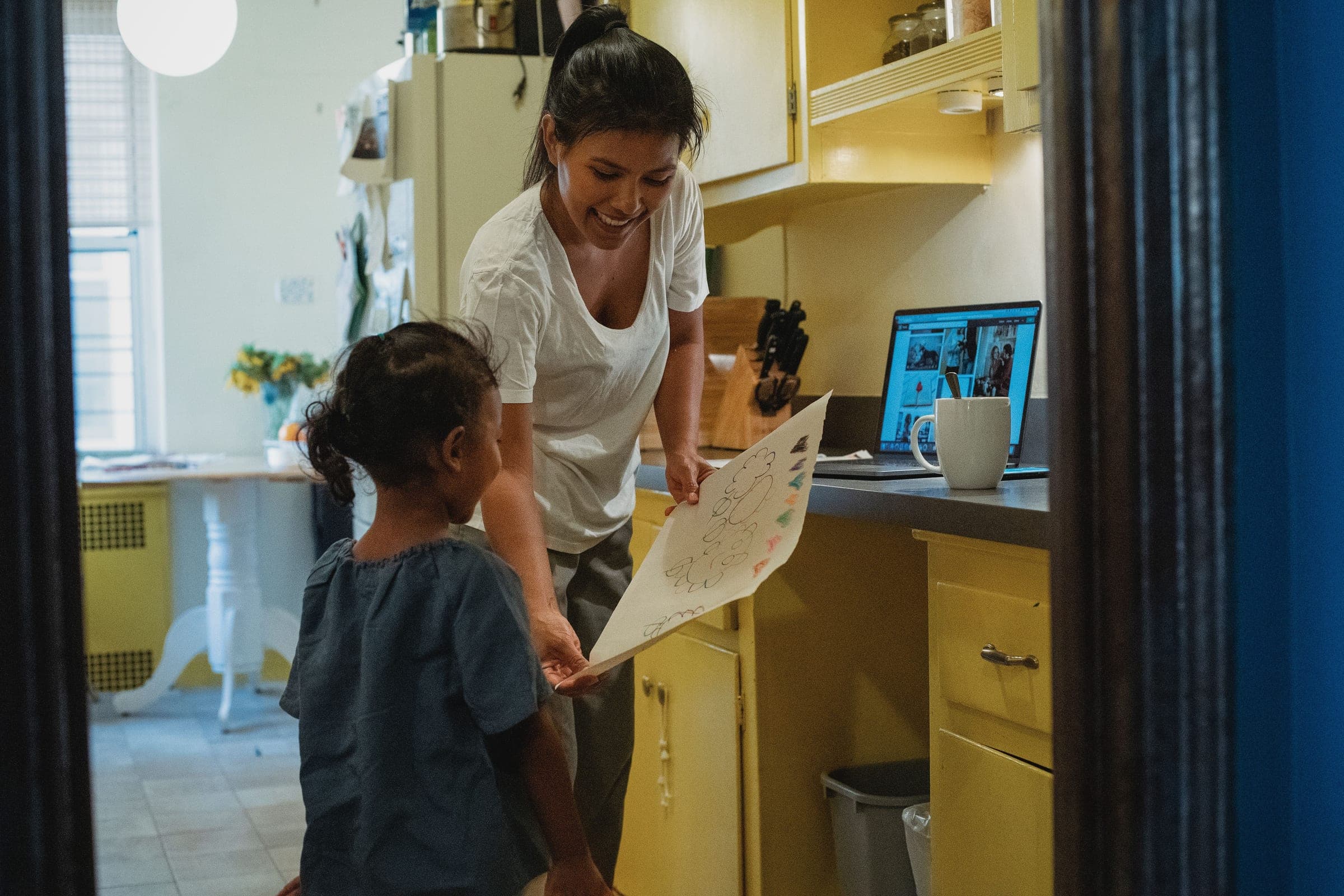
"I'm stupid", "I never get anything right", "I'm the worst" — a parent hears this and answers almost by reflex: "Don't be silly, you're the cleverest of all!" The child gets angrier still. Self-esteem is not something you can top up with praise like water in a glass; research of recent years shows that generous praise of a child's qualities harms most precisely those children who doubt themselves. Below is not a list of tips but one scene taken apart: what to find out before acting, what to choose between, what each choice leads to, and what is known about it.
The scene
An eight-year-old tears up his drawing: "It's all crooked. I'm stupid, I can't do anything." You: "Come on, it's very beautiful!" He: "You're only saying that!" — and goes off to his room.
One and the same scene is several different situations. They differ not in the child's words but in what stands behind them, and that decides what to do. The scene is an illustration, not a real family.
What to find out before acting
- Is it about the task or about himself? "It didn't come out straight" and "I'm stupid" are different things. The first is frustration, and it passes with the task. The second is a conclusion about himself, and if it comes regularly, the work is not about the drawing.
- What do you usually praise him for? "Clever", "talented", "the most gifted" is praise of the person. "You spent a long time choosing the colour", "you redid it and it got better" is praise of the action. The research below shows that in children with shaky self-esteem the first turns into shame at the first failure.
- Who does he compare himself with? A brother, a classmate, other people's drawings in a feed. From about seven or eight comparison becomes accurate: the child sees that someone draws better, and it is true. Arguing with the truth is useless.
- Where does the word come from? "Stupid" is a word he heard somewhere: from a teacher, from the other kids, at home. If he is repeating someone else's word, the source matters more than his self-esteem.
- How many attempts before "I'm stupid"? Giving up at the first line is fear of mistakes. Getting angry after the tenth is perfectionism and tiredness. They are treated differently.
The forks: what you can do and what each one costs
If it is frustration with the task ("it didn't come out")
Action. Do not argue with his verdict and do not praise the drawing — he knows the line is crooked. Name the fact and the feeling: "the line went sideways, and you're angry because you wanted it straight." Then to the process: "what got in the way? want me to show you how to hold your hand?" Break the task into a step that will definitely work. Praise — for a specific action after it has happened, not in advance.
Cost. Holding back the consoling "it's beautiful!" is hard, because it calms you, not him. And admitting out loud that it did not work out: that is honesty he will believe.
What to watch. Whether he comes back to the task by himself. If he does, the scene is closed.
If "I'm stupid" is already about himself and keeps coming back
Action. Rebuild your own speech, not his: drop praise of the person ("clever", "talented", "you're gifted, you're just lazy") and comparisons that grade him; praise a specific action; instead of a verdict, a question: "what do you like about it yourself?" Find the source of the word "stupid": school, the other kids, home. Show your own mistakes out loud: "I mixed that up, I'll try another way" — so the child sees that a mistake is not a sentence.
Cost. Changing your own habits is slower than one conversation, and the result shows in months, not days. The comfort of "you're the best" has to be given up — it does not work as a counterweight, and you can see why below.
What to watch. Whether the self-blame comes less often after a month or two. Whether he takes on new things. If the phrase persists and sleep, appetite and mood have joined it — the section "when to see a specialist".
If he gives up at the first attempt and avoids anything new
Action. Not "you can do it!" but "let's look at exactly where it's hard." Tasks with manageable difficulty — where effort reliably produces a result. Do not do it for him and do not cushion him in advance. An activity with no grades and no audience: building sets, cooking, sport "for himself". And do not turn every attempt into an exam by the whole family's attention.
Cost. Your patience and giving up the safety net: he will have to make mistakes in front of you, and you will have to not rescue him.
What to watch. Whether he tries new things without being talked into it. Whether a mistake is an event or a catastrophe.
There are no ready-made lines here on purpose: every family has its own words. All three forks mean the same thing: praise the action, not the person, and leave the child the right to fail.
What may be behind it
- Praise of the person. A child praised for "brains" and "talent" begins to fear losing them — and every failure becomes proof that he is not like that after all.
- Comparison. "Look how Masha does it" — even as praise. From seven or eight children compare themselves, and accurately; an extra comparison from an adult finishes the job.
- A bar set above the age. "You have to be the best" — self-esteem is tied to the result, and the result is not always reachable.
- A word from outside. A teacher, the other kids, an older brother: "stupid" may be a quotation. Then this is the section on bullying, not self-esteem — see the case on bullying.
- Mood. If self-deprecation goes on for weeks and sleep, appetite and interest in favourite things have changed with it, this is not about the drawing.
What research says
Children with low self-esteem get more praise of the "person" — and it is they whom it harms
Who and on whom. Eddie Brummelman, Sander Thomaes and colleagues, 2014, Journal of Experimental Psychology: General. Two studies: 357 adults and 313 children of about 10.
What they found. Adults are inclined to praise children with low self-esteem for their qualities ("you're clever") rather than for their actions. But it is praise of the person, not of the action, that predisposes children — especially those with low self-esteem — to shame after failure: the child attributes the failure to himself.
What it does not prove. The Netherlands, an experiment with one task, a short horizon. The study is about a mechanism, not about praise being harmful in general: praise of the action produced no such effect.
Inflated praise teaches a child with low self-esteem to avoid hard things
Who and on whom. The same group, 2014, Psychological Science. An experiment and a naturalistic study with adults plus an experiment with children.
What they found. Adults are especially inclined to give inflated praise ("incredibly beautiful!") to children with low self-esteem. In those children it reduced the willingness to choose challenging tasks; in children with high self-esteem the effect was the opposite.
What it does not prove. Laboratory tasks, one country. But the hint is clear: "incredibly" is heard as a bar to keep meeting, not as support.
Praise for intelligence rather than effort turns against the child after failure
Who and on whom. Claudia Mueller and Carol Dweck, 1998, Journal of Personality and Social Psychology. Six studies with fifth-graders.
What they found. Children praised for intelligence showed, after failure, less persistence and less enjoyment of the task, more often explained the failure by lack of ability and performed worse than children praised for effort; they also described intelligence as a fixed trait.
What it does not prove. One age group, the United States, laboratory tasks. The direction, however, matches the two studies above.
Self-esteem normally rises from 4 to 11 and stands still from 11 to 15
Who and on whom. Ulrich Orth, Ruth Erol and Eva Luciano, 2018, Psychological Bulletin. A meta-analysis of 331 samples, 164,868 people aged 4 to 94.
What they found. On average self-esteem increases from age 4 to 11, stays stable from 11 to 15 and then rises strongly until 30. The pattern held regardless of gender, country and birth cohort.
What it does not prove. These are average trajectories, not a norm for any one child. But two conclusions are practical: a drop in self-esteem in a primary-school child is not "just the age" but a reason to look at school and surroundings; and a teenager's "frozen" self-esteem is exactly the age.
For a parent the four studies point the same way: self-esteem is not raised by words about how wonderful the child is. It is built by the experience of "I did it, and it worked" and by an adult who notices the action rather than grading the person.
By age
| Age | What changes |
|---|---|
| 2–4 | Self-esteem means "I am loved and welcome". The child cannot yet evaluate himself, but he already hears what he gets noticed for. Noticing actions ("you put your boots on yourself") works from this age; comparing does not, in either direction. |
| 5–7 | The first comparisons at nursery and in the first year of school. "I can't" is more often about the task: break it into steps, show that skill grows. Labels — "our artist", "our mathematician" — already stick. |
| 8–11 | The case above is about this age. Comparison becomes accurate; marks and rankings appear. Normally self-esteem grows in these years; if it falls, look at school, the other children and how praise is given at home. |
| 12–14 | The plateau in the meta-analysis: a teenager does not "blossom", and that is normal. Body, social media, status in the group. Any criticism of appearance is off limits; support comes through an activity where he is competent, not through words about him. |
Where culture comes in. In some families and countries praise is generous and public, in others restrained and rare. The forks above are not about the amount of praise but about its address: the action, not the person — and that works in any culture.
When to see a specialist
Frustration over a crooked line is part of growing up. Take notice if self-deprecation goes on for weeks and over anything at all; if sleep, appetite and mood have changed with it, the child has dropped what he loved and withdrawn; if phrases like "it would be better if I didn't exist" or "everyone's better off without me" appear — with these you go to a child psychologist or psychiatrist without delay. If school stands behind the words — mockery, exclusion from the group — that is the section on bullying, and it is the bullying that needs dealing with.
What a child learns when you don't argue with "crooked"
He learns that the truth about a result and love for him are not the same thing: the line is crooked, and he is still yours. That a mistake can be named and fixed rather than hidden. And that he can judge himself by his actions rather than by labels — including the ones that come from other people's mouths. How to name a feeling before it turns into "I'm stupid" — in the article on emotional intelligence; how to hold back your own outburst in a scene like this — in the case on parental anger.
Sources
- Brummelman E., Thomaes S., Overbeek G., Orobio de Castro B., van den Hout M. A., Bushman B. J. On feeding those hungry for praise: Person praise backfires in children with low self-esteem. Journal of Experimental Psychology: General, 2014, 143(1), 9–14. doi:10.1037/a0031917
- Brummelman E., Thomaes S., Orobio de Castro B., Overbeek G., Bushman B. J. "That's not just beautiful—that's incredibly beautiful!": The adverse impact of inflated praise on children with low self-esteem. Psychological Science, 2014, 25(3), 728–735. doi:10.1177/0956797613514251
- Mueller C. M., Dweck C. S. Praise for intelligence can undermine children's motivation and performance. Journal of Personality and Social Psychology, 1998, 75(1), 33–52. doi:10.1037/0022-3514.75.1.33
- Orth U., Erol R. Y., Luciano E. C. Development of self-esteem from age 4 to 94 years: A meta-analysis of longitudinal studies. Psychological Bulletin, 2018, 144(10), 1045–1080. doi:10.1037/bul0000161
The scene is an illustration, not a real family. This material does not replace an in-person consultation with a specialist.